Strategic Zoom Guide: Orbit to Frontline
How the Strategic Zoom system works, why it is the defining control of Ashes of the Singularity II, and how to read a battlefield with it.
Quick Answer: What Is Strategic Zoom?
Strategic Zoom is the camera system that lets you orchestrate movements from orbit down to the frontline in one continuous view. In Ashes of the Singularity II it is not a convenience — it is how a battle between thousands of units across continent-sized battlefields stays readable, and it is the first control the game's official description names.
Why a Zoom Level Is a Reading Level
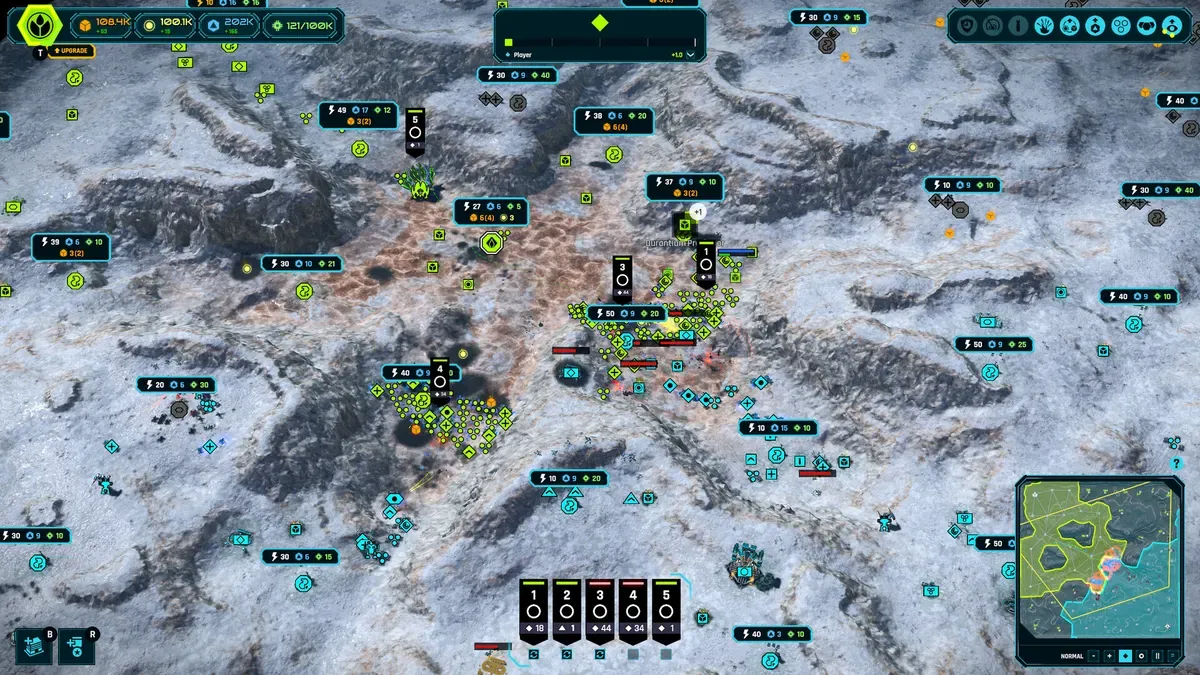
Every zoom height answers a different question. At orbital height, the map is a strategy document: where your economy stands, where the enemy is committing, which regions are converting to Turinium, and where the next ten minutes of the war will be decided. Mid-level, the map is an operational picture: army positions, fronts, and the corridors between them. At ground level, the map is a battle: individual engagements, terrain features, and the aftermath of fights already lost or won. The skill the game rewards — the one the official description celebrates as strategic skill rather than reflexes — is moving between those readings without losing track of the war as a whole.
What the Zoom Changes About RTS Skill
| Traditional RTS Skill | The Strategic Zoom Equivalent |
|---|---|
| Fast camera jumps between hotkeys | Smooth zoom as a continuous reading of the theater |
| Per-unit micromanagement | Formation-level orders that stay valid across zoom levels |
| Minimap glances | The zoomed-out view itself — the whole map stays one picture |
| Actions per minute | Decisions per battle: fewer, larger, better-timed |
Practical Reading Habits for Massive Battles
- Open every engagement zoomed out first: the answer to "should I fight here" is visible from orbit long before it is visible at ground level.
- Watch Turinium spread as a live scoreboard — terrain transformation shows who is winning the map, not just the fight.
- Treat the frontline as a place you visit, not a place you live: the official design promises that planning beats reaction, and planning happens zoomed out.
- When a battle goes wrong, re-read it from orbit before reacting — the cause is usually a supply or positioning decision minutes earlier, visible only at height.
How This Compares to Other RTS Camera Systems
Most strategy games treat the camera as transportation — a way to move your eyes between points of interest. Ashes of the Singularity II treats it as analysis: the official description ties Strategic Zoom directly to the game's identity ("orchestrate movements from orbit to frontline"), because at a scale of thousands of units, no fixed view can hold the battle. If you have played games with similar zoom-out cameras, the muscle memory transfers; what is new here is the density underneath it — continent-sized battlefields where terrain itself transforms mid-fight, which gives every zoom level something structural to read, not just units to count.
Zoom and the Rest of the Game's Systems
Strategic Zoom is the lens the other systems are read through, which is why this guide sits at the center of the site. The Turinium economy becomes legible from orbit: conversion spreading across regions is a strategic scoreboard no minimap could summarize. Logistics becomes manageable: supply lines and army positions are exactly the kind of pattern that only appears at height. Even the faction guides assume it — the Substrate's map-wide influence and the Post-Humans' infrastructure playstyle are both reads you make zoomed out before you act zoomed in. And when the game ships, the per-map catalog will lean on the same principle: each map's entry will describe what its layout looks like from orbit first, because that is how the game itself is played.
Frequently Asked Questions
Is Strategic Zoom new to the sequel?
Do I need the zoom to win, or is it optional?
What are the default zoom keybindings?
Published November 7, 2026 · Last updated November 7, 2026